15.10.25 | By Vivid Imagination
Adidas: The brand that never left the streets (even when it was on the catwalk)
Some brands chase the next trend. Adidas just keeps owning the moment.
While most brands scramble to reinvent themselves every few years, Adidas just keeps doing what it’s always done, staying at the heart of culture.
Adidas has been a brand that’s thrived not by chasing the next win, but by sticking to something more profound: the Corinthian spirit. The original Olympic ideal that sport is not just about triumph but about togetherness, fair play, and mutual respect.
Contrast that with Nike, the self-anointed Greek god of victory. It’s right there in the name. Nike celebrates the individual: the winner, the record-breaker, the icon standing alone on the podium. Adidas? Adidas celebrates the collective, the team, the terrace, the tribe.
From the Bronx to Berlin, from Britpop to the Bundesliga, those three stripes haven’t just survived decades of fashion cycles, they’ve defined them.

The stripes that never slipped
The genius of Adidas isn’t just in its product, but in its positioning. Those three stripes are more than a logo – they’re a symbol of belonging. From the tracksuits of 1970s B-boys in the Bronx to the terraces of Manchester in the ‘90s, Adidas has always had a knack for being exactly where culture happens.
It wasn’t marketed there, it was adopted there. That’s a crucial difference most modern CMOs don’t understand. You can’t buy authenticity, you earn it.
When Run DMC held up their Superstars at Madison Square Garden and shouted “My Adidas” in 1986, they weren’t reading from a script. It was real. It was raw. And Adidas, to their credit, recognised the power of that authenticity and built one of the first-ever brand partnerships in music history.
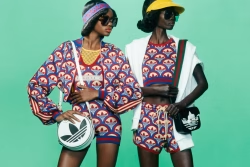
Fast forward to the 2000s, and the brand that once dressed rappers was collaborating with Stella McCartney and Gucci. Same stripes, different audience. That’s the power of a flexible, emotionally resonant brand platform, it can live in the club, the catwalk, or the football pitch and never feel out of place.
Adidas doesn’t chase trends; it collaborates with them. It doesn’t sell nostalgia; it activates it.
Made for it
Which brings us neatly to 2025 and Oasis Live25, the long-awaited reunion tour. It’s not just about Britpop nostalgia, it’s a cultural reconnection. And standing right there, front and centre, is Adidas Originals.
Anyone who went would have seen teenagers and adults alike draped in the latest collab. If the ticket prices weren’t enough to end world hunger, the merch sales certainly would.
It’s the perfect encapsulation of the Adidas brand in motion: timeless, collective, and authentic. Adidas doesn’t borrow from culture; it belongs to it.
The merchandising success of Originals in the wake of the tour isn’t luck. It’s the logical result of decades of brand consistency. Adidas never forgot who it was: the brand of the people, for the people. The stripes have been worn by football hooligans, hip-hop legends, indie rockers, and high-fashion elites. That’s not brand confusion, that’s brand elasticity.
And if, like me, your feed consists of Newcastle United and Oasis, your bank balance is waving a white flag.
In 2023 Adidas signed a new multi-year partnership with the club, a brand that holds a special place in the hearts and minds of the supporters from the Entertainers era. Perfect when the club’s stock and profile are riding high, with eyes firmly fixed on the black and white stripes.
But what a time to be alive (and overdrawn). Adidas has managed to capture two distinct forms of northern pride, football and music, and blend them into something beautifully wearable.
This is what Adidas does best: connects tribes.
The original never dies
Adidas Originals is now the crown jewel of the brand portfolio, driving sales, shaping culture, and reminding marketers everywhere that heritage isn’t baggage. It’s ballast.
Every time a new drop lands, whether it be a collab with Gucci or now the Oasis Live25 line, it feels fresh, but also familiar.
Adidas doesn’t chase trends; it collaborates with them. It doesn’t sell nostalgia; it activates it.
Because when your brand stands for something real, something deeper than “victory”, you don’t have to reinvent yourself every quarter. You just have to stay true to the stripes.
Adidas has managed what most brands dream of and almost none achieve, cultural permanence. It’s not just a sportswear company, it’s a mirror to modern identity, fluid, collective, and endlessly remixable.
And in a world obsessed with winning, maybe it’s time more marketers remembered the lesson from Herzogenaurach.
Victory fades. Teams endure. And the stripes? They never go out of style.
Andrew Gibson
Creative Director